Thursday, February 7, 2013

Thuparamaya


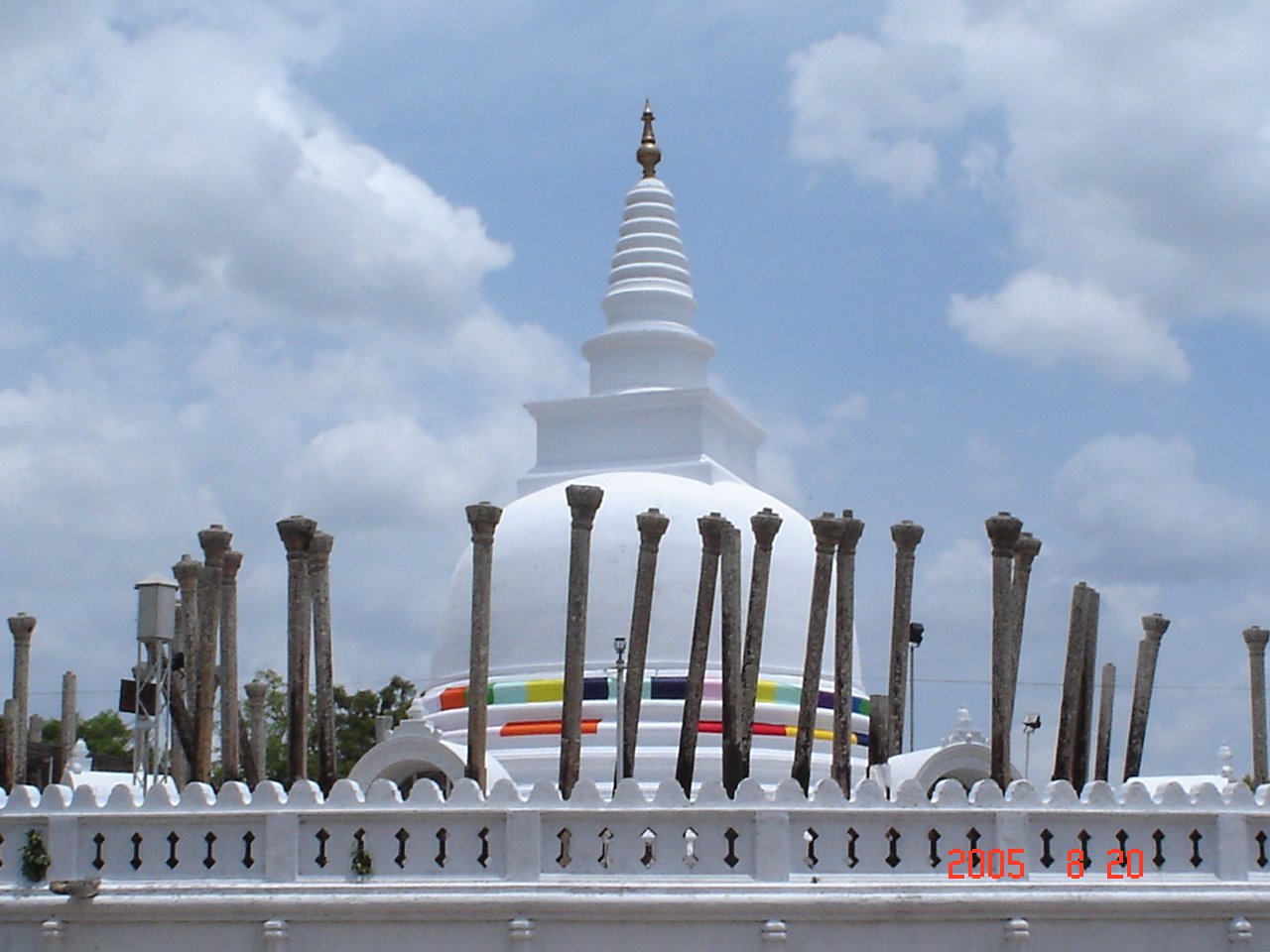
 is a dagoba in Anuradhapura with the base diameter of 18m and 3.45m in height. Thuparamaya, located in the heart of Anuradhapura is considered to be the first dagoba built in Sri Lanka following the introduction of Buddhism. This Chetiya was built in the shape of a heap of paddy enshrining the collarbone of the Buddha. Thuparamaya was destroyed and rebuilt from time to time with the current monument being rebuilt in 1862 AD.
Thuparamaya Dagoba, Anuradhapura, Sri Lanka by Bernard Gagnon (Wikimedia)Thuparamaya is surrounded by a granite compound and 2 rows of stone pillars round the dagoba. The stone columns around the dagoba were once supporting a ring shaped roof structure of Thuparamaya.
In 7th century BC, Thuparamaya stupa was rich with gold and silver decorations, bricks and doors. The dagoba was then plundered by the Pandyans (south Indian Tamil), who took away all its gold and treasures. Thuparamaya stupa was later renovated by King Mahinda IV, who re-installed the golden casings and doors. There was another attack on Thuparamaya stupa by Colas (south Indian Tamil), who completely plundered the complex of its valuables.


Ruwanwelisaya


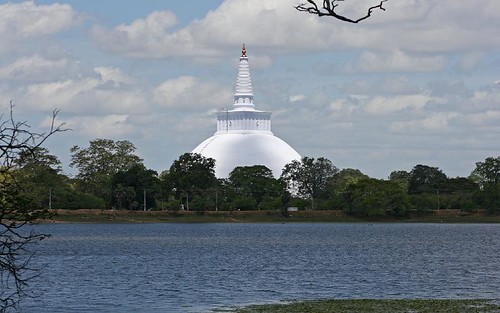
The Ruwanwelisaya is a stupa in Sri Lanka, considered a marvel for its architectural qualities and sacred to many Buddhists all over the world. It was built by King Dutugemunu, who became lord of all Sri Lanka after a war in which the Chola King Elara, was defeated. It is also known as Mahathupa, Swarnamali Chaitya and Rathnamali Dagaba.
The stupa is also one of the Solosmasthana (the 16 places of veneration) and theAtamasthana (the 8 places of veneration in the ancient sacred city of Anuradhapura). The stupa is one of the world's tallest monuments, standing at 300 ft (92 m) and with a circumference of 950 ft (292 m).


Sri Maha Bodhi (The Sacred Bo-Tree)


After bringing Buddhism to Sri Lanka by Mahinda Thero in 250 BC Emperor Asoka in India sent his daughter Theri Sanghamitta to the island with a branch of the Sacred Bodhi obtained from the main stem of the bodhi tree in Bodh Gaya under which Buddha attained enlightenment. The king Tissa received the sapling and planted it at the present site in 249 BC. Taking this information to account today (in 2004) is tree is exactly 2253 years old. Thus this tree is the oldest tree in world in the recorded history.


Even after the Apura was deserted as the capital of the country and encroached by the jungle, pious people nevertheless tendered to the tree effortlessly. The villagers lit bonfires to frighten off wild elephants. As the time went on the villagers made it a habit to collect firewood for the whole year on one single day. This possession was called “Daramiti Perahara” (Firewood Possession) which continues up to this day.
There are special guards who look after the Bodhi Tree. This again is an age old custom continued to date by people who live in the neighbourhood whose ancestors have received the land for their services. This may be probably one of the oldest surviving religious professions in the world.

Today you can see this 2250 year old tree which is helped by few metal towers and accompanied by 41 “parivara” (companion) trees.


Wednesday, February 6, 2013

Badulla


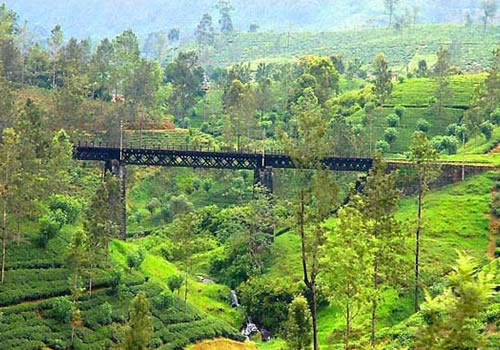
It is located on the southeast of Kandy, almost encircled by the Badulu Oya River, about 680 metres (2200 ft) above sea level and is surrounded by tea plantations. The town is overshadowed by the Namunukula range of mountains (highest peak 2,016 meters above sea level). It was the base of Sinhalese princes who ruled the area under the king in Kandy before it became part of the British Empire. Later, it became the administrative hub of the British rulers. The city was the end point of upcountry railway line built by the British in order to take plantation products to Colombo.

Badulla is about 230km away from Colombo towards the eastern slopes of central hills of Sri Lanka. There are
Multiple routes to Badulla from Colombo, Kandy and Galle. From Colombo, one can travel via Ratnapura, Balangoda, Haputale, Bandarawela and HaliElaalong A4 and A16 to Badulla which may take about 5-6 hours. From Kandy there are two routes. Either via "Victoria-Randenigala Raja Mawatha" or viaNuwara Eliya (route A5). From Galle, the best route is via Marata,Hambantota, Wellawaya, Ella, Demodara and HaliEla (route A2). All routes are scenic and one can get splendid views of geography changes while travelling. Badulla and surroundings are highly recommended for eco-tourists as Horton Plains National Park and the Knuckles mountains are few hours away.


Saturday, February 2, 2013

Semi-circular Moonstones


placed at the entrance of places is a sign of welcome to all visitors, also beside the moonstone are two columnar guard stones in order to prevent any evil spirits from entering. Known in Sinhalese as sandakada pahana, it is roughly translated into English as moonstone. The name is based on its shape and design. The ancient chronicle Mahavamsa and Pali literature such as the Samantapasadika refer to the sandakada pahana as patika. First seen in the latter stage of the Anuradhapura period, the sandakada pahana evolved through the Polonnaruwa, Gampola and Kandy periods. According to historians, the sandakada pahana symbolises the cycle of Samsara in Buddhism.

Friday, February 1, 2013

Vessagiriya - වෙස්සගිරිය


Vessagiriya  is located few hundred meters left to the current Isurumuniya on the old Anuradhapura-a-Kurunegala road. This temple complex is located in and around 3 beautiful bolder formations spread across a large area in front of the Tissa Weva. On one these is a remains of a dagaba.
Remains of 23 caves with drip ledges which the monks used can be seen on two of the rock formations. Remains of many buildings had been found from around the site, among which there were remains of an image house (pilima geya), dagoba and refectory (monk's dining room). Bricks recovered from the dagoba had Sinhalese characters belonging to the 10th and 11th centuries. Also there is a remains of a rate type of a circular building devoid of any statues or pedestals. Although the purpose of the this building is still a mystery, archaeologists have found seventy rare coins on excavating this building.  
This site has been housed to 500 priests who received ordinance from the great thero Mahinda, who brought Buddhism to the country in 250 BC.


Isurumuniya Viharaya - ඉසුරුමුණිය විහාරය


It is mentioned in the Mahavamsa that the Isurumuniya was built by king Devanampiya Tissa (250-260 BC) for the benefit of the 500 Ksatriyas who embraced Buddhism soon after the introduction of Buddhism by Rev. Mahinda. The stone carvings seen at Isurumuniya indicate some south Indian influences; these carvings have led to heightening of the prestige of the place. A few of these carvings are mentioned below:


i)    The pair of lovers
ii)    The man and the horse head
iii)    The figures of the swimming elephants
iv)   Figures of the royal family.


The Meghagiri Vihara is now commonly known as Isurumuniya Vihara or Isurumuniya. But the real Isurumuni Vihara is located few hundred metres away is now called Vessagiri Vihara.


Isurumuniya is most famous for the stone carving of a couple located there. This carved stone was found in the royal pleasure garden and brought here. There are many interpretations for this carving.
The most popular is that this carving shows the prince Saliya (the son of the great king Dutugamunu) and his mistress Asokamala. Asokamala was of a lover cast called “Chandala” and the prince Saliya gave up the right to be the king by marrying this girl of a lower cast.


Another belief is that this couple represent the god Siva and goddess Parvathiof Hindu belief.
The vihara also has another stone slab which depicts a court scene which is thought to be the court of king Dutugemunu. Both these stone slabs are thought to be originated in the 8th century.

The vihara itself is built on a rock and the sacred tooth relic of Buddha has been originally kept here when it arrived to the island from India in the 312 AC.
At the entrance to the rock temple is a large pond. Above the pond there is a carving of bathing elephants and on the top level of the stairs there is another carving of a man seated in a royal pose and a horse head. The top carving is thought to be carving of Agni and Parjanya. Parjanya is the god for rain. The elephants below represent the the clouds. With this interpretation it is believed this place was also used by the king to perform ceremonies for rain god.
The stupa and the Buddha image in this temple are of recent origin. But there are some caves which probably were used earlier but now have become a haven for bats.